
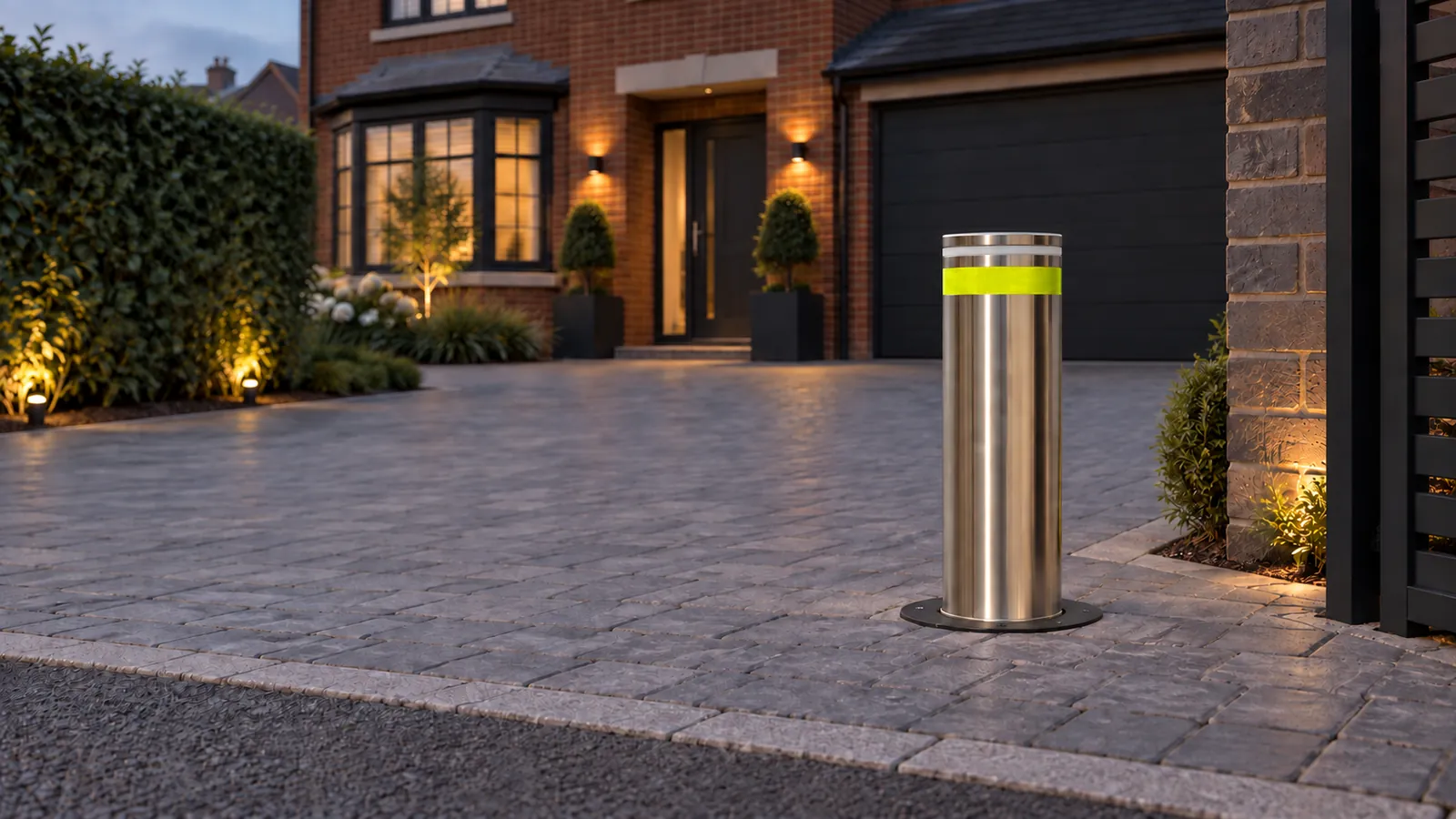
Automatic driveway bollards that keep your drive yours
A Boliq automatic bollard rises from your driveway to stop other people parking on it and to block your own car from being driven away, then drops flush at the press of a key fob. Boliq Sentry is £2,495 fully installed, runs on a battery as standard (mains is optional), and can be ordered online with a few photos of your drive.
Most vehicle theft happens at home
Vehicle-related theft in England and Wales fell to about 596,000 incidents in the year to December 2025, but where it happens has not changed.1 In the Crime Survey for England and Wales, around 79% of vehicle-related thefts took place on the victim's own land, on a driveway or garage area, or in the street outside their home. For thefts of the whole vehicle, 51% happened on the home's own premises.2
Most of it happens after dark: about 80% of incidents are in the evening or at night.2 And in 47% of thefts of a whole vehicle, the thief got in by manipulating the signal from the car's remote locking.2
A bollard cannot stop a relay attack on your key. What it can do is sit raised in front of your car, so that even if someone gets in, they cannot drive it off the drive. Raise it at night on a schedule, or with a key fob when you get home.
The everyday driveway problems a bollard fixes
People parking on your drive
When someone parks on your driveway, the police usually treat it as a civil matter, and clamping or removing the car yourself can be a criminal offence.34 A raised bollard stops it happening in the first place.
Your car being driven away
With the bollard raised in front of it, your car cannot be driven off the drive, whether the thief has your keys, has cloned the signal or has broken in.
Turning and blocking
Stop drivers using your drive to turn round, or blocking it while they pop to the shops. Lower it with a fob as you arrive, raise it as you leave.
No gate, no digging for cables
A bollard takes a fraction of the space of a gate and keeps the front of your home open. Battery power means no trench across the drive and no electrician.
Visitors and deliveries
With the optional app, lower it from anywhere for a family member, a delivery or a tradesperson, then raise it again when they have gone.
Works in the dark and the cold
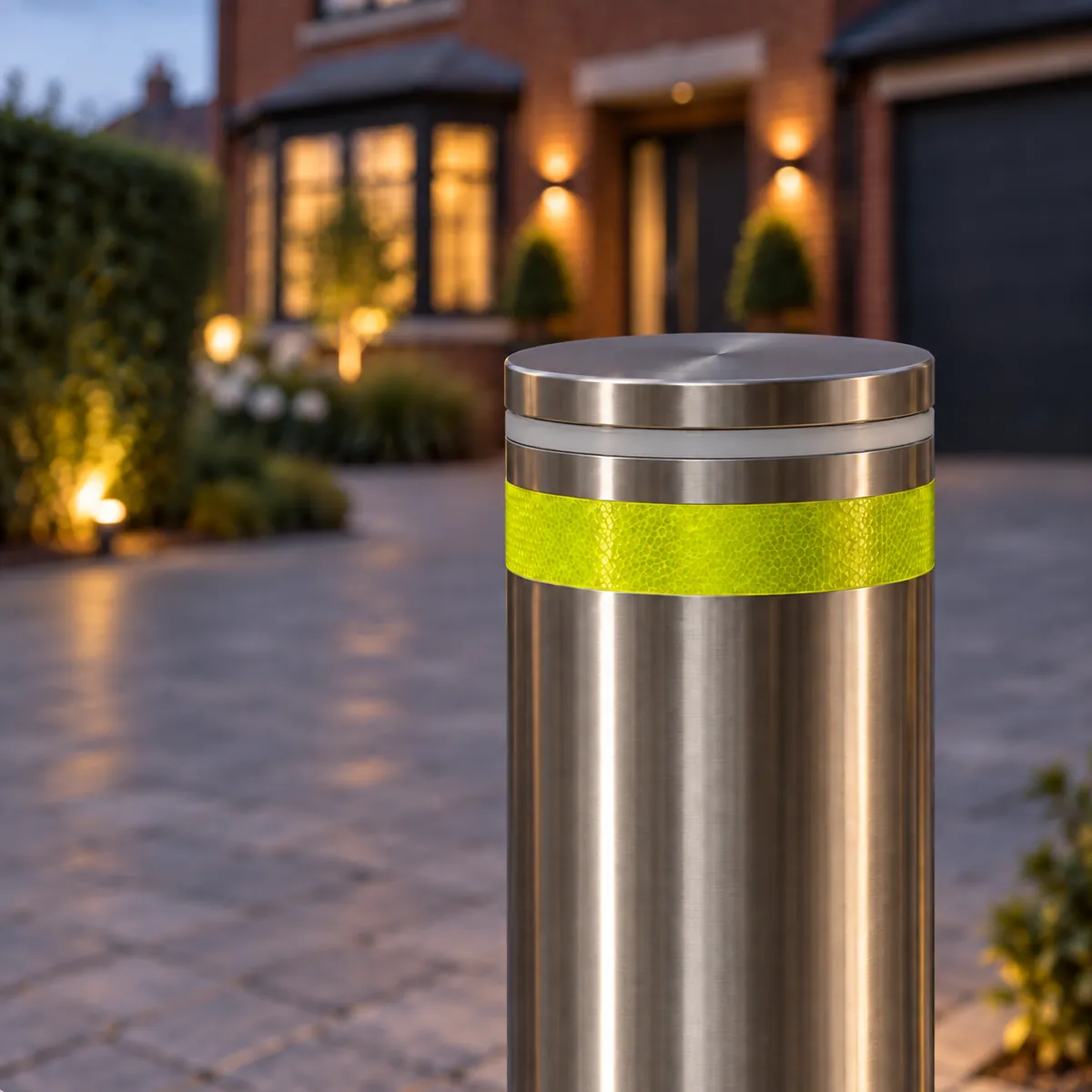
An LED light ring and reflective band keep it visible at night, and it is rated to operate down to minus 40 °C.
Which bollard for your driveway?
Both models are fully installed with two key fobs and run on a battery. Sentry Max is the heavier-duty of the two.
| Boliq Sentry | Boliq Sentry Max | |
|---|---|---|
| Price, fully installed | £2,495 | £3,495 |
| Best for | Most single driveways | A heavier-duty, more robust barrier and stronger deterrent |
| Raised height | 600 mm | 600 mm |
| Power | Battery, mains optional | Battery, mains optional |
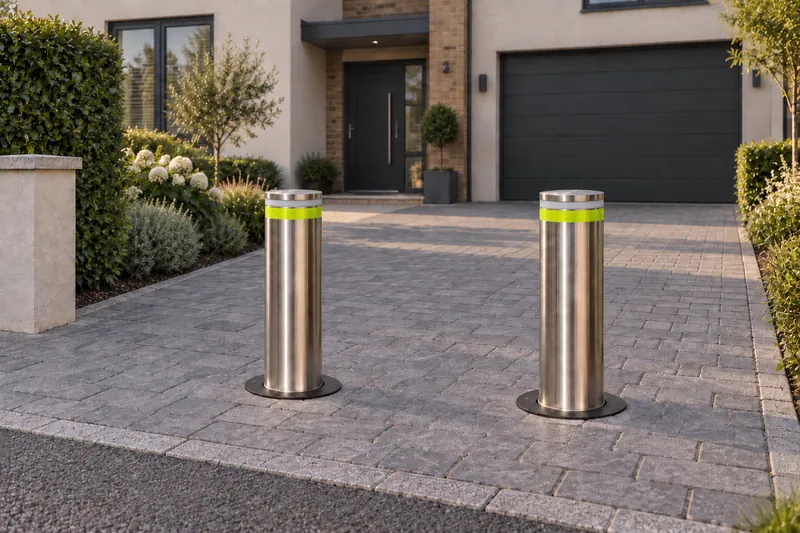
| How many | One bollard covers a single car width. Wider drives usually take two, spaced so a car cannot pass between them. Work out yours with the driveway planner. | |
Do I need planning permission for a driveway bollard?
It depends, so check before you install. In England, "permitted development" lets you put up a gate, fence, wall or other means of enclosure without planning permission, up to 1 metre high next to a road used by vehicles.5 Bollards are not named in those rules, and in a 2023 appeal a planning inspector decided that a row of 500 mm rising bollards across a front garden was not a "means of enclosure", so it was not permitted development.8 That decision turned on the facts of one site, but it means you should not assume a driveway bollard is automatically covered.
Whether a bollard runs on battery or mains power makes no difference. Planning law judges whether something is a building or structure by its size, its permanence and how it is attached to the ground, and a rising bollard's housing is set in a concrete foundation, so it is a permanent installation either way.910 The rules for temporary structures only cover things needed while building work is carried out, or uses of land for up to 28 days a year.11
The simplest way to be sure is to ask your council's planning team, or to apply for a lawful development certificate, which gives you a formal answer before anything is installed.12 You will need permission for a listed building, and possibly in a conservation area or where your council has removed permitted development rights with an Article 4 direction or a planning condition.56 Wales and Scotland have their own permitted development rules. We quote individually for listed buildings and conservation areas.
We can apply for you. If you want a formal answer before we install, our partner architect or building company can prepare and submit the application on your behalf: a lawful development certificate for £395, or a full householder planning application for £595. Both prices are for homes in England and include the council's fee; homes in Wales and Scotland are quoted individually. We book your installation once the council has decided, and if permission is refused you get your deposit back in full. See our planning service terms.
Raise it before, not after
Clamping or immobilising a vehicle on private land has been a criminal offence in England and Wales since 2012. The law makes an exception for a fixed barrier that was already in place when the driver parked.4
So use your bollard to keep the drive clear, and never raise it to trap a car that is already parked there. If someone has parked on your drive, the Metropolitan Police advise a written notice and a DVLA keeper request rather than taking matters into your own hands.3
From order to your first press of the fob
1. Order online. Choose your model and send a few photos of your driveway. No site visit is needed for tarmac, block paving, poured concrete, gravel or paving slabs.
2. We install it. We dig a hole about 40 × 50 cm and 90 cm deep for both Sentry and Sentry Max, lay a free-draining sand and gravel bed, and set the bollard in concrete flush with your drive. No drain connection, and no cables to lay on battery power.
3. Use it. After about 72 hours for the concrete to cure, it is ready. Two key fobs are included; the app is optional at £9.95 a month.
Driveway bollard questions
How much does an automatic driveway bollard cost?
Boliq Sentry is £2,495 and Sentry Max £3,495, fully installed with two key fobs on a standard driveway. There is no VAT to add. The optional app and SIM is £9.95 a month.
Will a driveway bollard lower my car insurance?
We cannot promise that. Insurers advise keeping your car on a driveway or in a garage to deter thieves, but whether a bollard changes your premium is up to your insurer, so ask them.7
Can I get out if the battery runs flat?
Yes. The bollard can be pushed down by hand in a power cut or with a flat battery, so your car is never trapped. The light ring flashes when it needs charging.
What if a car is over it when it rises?
It will not rise. A sensor in the top cap detects anything resting on it, and it also stops if it meets resistance while rising, resetting from the fob once clear. Always check the area is clear before raising it.
Does it work on a resin or imprinted driveway?
Yes, but these surfaces cannot be cut and patched to match, so we price them individually rather than at the fixed online price. Send us your details.
Do I need the app?
You don't need it, because two key fobs are included and operate the bollard. The Boliq app adds control from anywhere, schedules and alerts for £9.95 a month, and it is what lets you lower the bollard for a delivery or a visitor when you are not home.
Sources
- Office for National Statistics, Crime in England and Wales: year ending December 2025, April 2026.
- Office for National Statistics, Nature of crime: vehicle-related theft, year ending March 2025, March 2026.
- Metropolitan Police, Problems with parking.
- Protection of Freedoms Act 2012, section 54.
- Town and Country Planning (General Permitted Development) (England) Order 2015, Schedule 2, Part 2, Class A.
- Planning Portal, Fences, gates and garden walls: planning permission.
- Association of British Insurers, Vehicle security guidance.
- Development Control Practice, A load of old bollards, report of planning appeal decision 400-041-388, 7 August 2023.
- Town and Country Planning Act 1990, section 336: a building includes any structure or erection.
- Appeal decision APP/J4423/C/25/3369982, Planning Inspectorate, 2 January 2026, applying the Skerritts and Cardiff Rating tests of size, permanence and physical attachment.
- General Permitted Development (England) Order 2015, Schedule 2, Part 4 (temporary buildings and uses).
- Town and Country Planning Act 1990, section 192 (certificate of lawfulness of proposed use or development).
Last updated 28 September 2026. The planning and parking guidance above is for England (and, for clamping, Wales); rules in Scotland differ. This page is general guidance, not legal advice.