
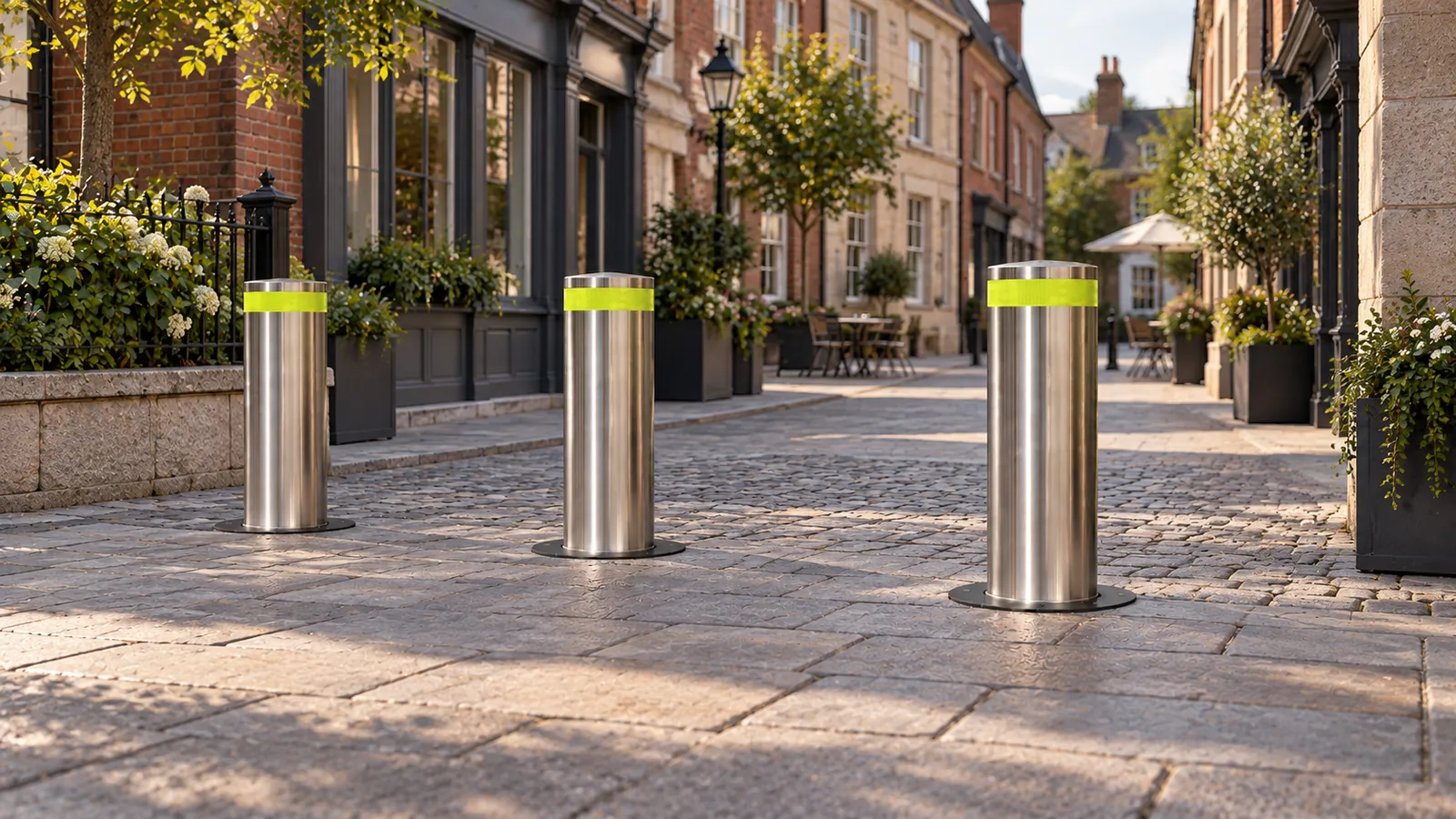
Rising bollards for town centres, pedestrian zones and private roads
Boliq Sentry Max controls vehicle access to pedestrianised streets, market squares, service roads, private roads and estates: raised to keep traffic out, lowered at set times or on request for deliveries, residents and emergency vehicles. It is £3,495 per bollard installed, with app control and bespoke links to control rooms and intercoms. It is an access control bollard, not a hostile vehicle mitigation product.
Timed access for streets, squares and private roads
Rising bollards let a street work two ways: open to delivery vans in the morning, closed to traffic when it fills with people. Schedules raise and lower each bollard at set times, and the app or a control room can open them in between.
- Pedestrian zones with delivery windows
- Market squares and event days
- Private and unadopted roads, and residential estates
- Campuses, business parks and service roads
- Access routes that must stay clear for emergency vehicles
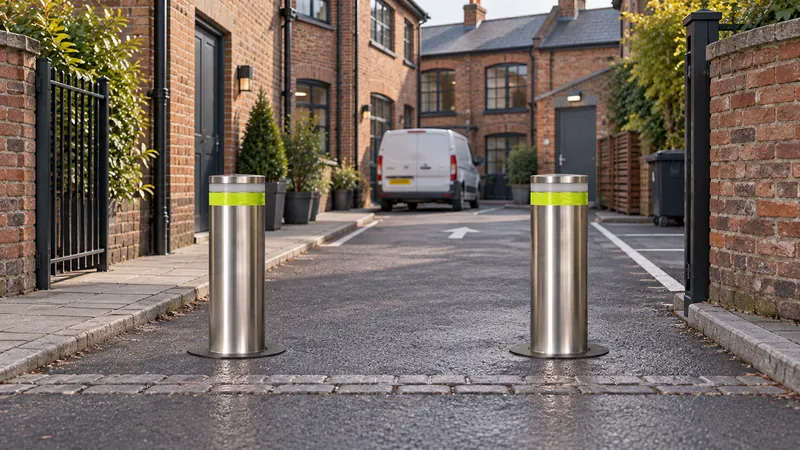
How vehicle restrictions on a public road work in England
On a public highway, the bollards are the physical part of a traffic restriction that the highway authority makes and owns. We work with the authority, landowner or managing agent on the installation and control.
| Legal basis | Traffic authorities restrict traffic through Traffic Regulation Orders under section 1 of the Road Traffic Regulation Act 1984, for reasons including safety, helping pedestrians and preserving amenity.1 Highway authorities may also place posts and barriers in the highway to safeguard its users.2 |
|---|---|
| Signs | Pedestrian zone entry signs are prescribed in the Traffic Signs Regulations and General Directions 2016 (diagrams 618.3B and 618.3C), and a warning sign can carry the legend "Rising bollards".3 |
| Signals | Where rising bollards have signals, TSRGD 2016 prescribes red and green aspects only, with red shown while the bollard is raised.3 |
| Trial schemes | Many schemes start as experimental orders. In DfT research on 99 low traffic neighbourhoods, 82% remained in place, most often after an experimental order was made permanent.4 |
| Cameras as well | Since May 2022, councils in England outside London can apply to enforce moving traffic restrictions with cameras.5 Bollards physically stop the vehicle; cameras fine it afterwards. Some schemes use both. |
| Private roads | On a private or unadopted road, access is normally the landowner's decision, subject to any rights of way. Check deeds and rights before restricting access. |
Designing around pedestrians
Department for Transport guidance recommends that bollards in pedestrian areas are at least 1,000 mm high with a contrasting top, never linked by chains, and leave at least 1,000 mm clear for people to pass. Security bollards should leave gaps of no more than 1,200 mm.67
Boliq Sentry Max rises to 600 mm, with an LED light ring and a reflective band. Where a scheme places bollards among pedestrians, we plan the layout, spacing and marking with the highway authority, and we will tell you plainly if the guidance points to a taller bollard for your site.
Access control, not hostile vehicle mitigation
Boliq bollards control everyday vehicle access. They are not crash tested and must not be used to protect crowded places from deliberate vehicle attack.
For that, the National Protective Security Authority recognises barriers rated to ISO 22343-1, which replaced PAS 68 and IWA 14-1 for products tested from March 2024.8 A scheme can combine both: tested barriers where the risk needs them, and Boliq bollards for day-to-day access elsewhere.
Run on a timetable, open on request
- Schedules to raise and lower each bollard at set times
- Remote control from the app, for every bollard in a scheme
- Alerts when a bollard reports a fault or loses power
- Built-in mobile connection, so no street WiFi or data cabling
- Bespoke links to intercoms, control rooms and monitoring stations
Street and estate schemes are usually mains powered, so bollards used many times a day never need charging: £35 per metre of 24 V DC cable, with the converter supplied and fitted for £195 if you want it. We plan emergency vehicle access with the authority and emergency services as part of every scheme.
Councils, BIDs, estates and landowners
Highway authorities, town and parish councils, business improvement districts, managing agents, residents' associations and owners of private roads and campuses.
Every scheme starts with a conversation about the street, the traffic, the users and the legal basis, followed by a site review and a written proposal.
Town centre and private road questions
Do rising bollards on a public road need a Traffic Regulation Order?
Restricting vehicles on a public highway is normally done through a Traffic Regulation Order made by the traffic authority under the Road Traffic Regulation Act 1984. The bollards enforce the order; they do not replace it.
Can emergency vehicles get through?
Every scheme needs an agreed way for emergency services to get through, such as remote lowering by a control room or an access arrangement agreed with the fire and ambulance services. We plan it into the design.
Are Boliq bollards crash rated?
No. They are access control bollards and are not crash tested. For hostile vehicle mitigation, specify barriers rated to ISO 22343-1.
How tall are they?
Sentry Max rises to 600 mm and is 219 mm in diameter. Guidance recommends 1,000 mm bollards among pedestrians, so we plan layouts with that in mind and will advise if a taller bollard is needed.
What does a scheme cost?
Sentry Max is £3,495 per bollard installed. Mains power is £35 per metre of 24 V DC cable, with the converter supplied and fitted for £195 if you want it, and app control is £9.95 a month for the first bollard and £4.95 for each additional one. Signs, signals, traffic orders and integration are quoted per scheme.
Can a private estate install them without the council?
On a private or unadopted road, usually yes, subject to any rights of way and the terms of your title. On an adopted public road, the highway authority must be involved.
Sources
- Road Traffic Regulation Act 1984, section 1.
- Highways Act 1980, section 66.
- Traffic Signs Regulations and General Directions 2016, Schedule 8 Part 2, Schedule 14 paragraph 28 and Schedule 2.
- Department for Transport and Ipsos, Low traffic neighbourhoods research report, March 2024.
- Civil Enforcement of Road Traffic Contraventions (Approved Devices, Charging Guidelines and General Provisions) (England) Regulations 2022.
- Department for Transport, Inclusive Mobility, December 2021.
- Department for Transport, Traffic Advisory Leaflet 2/13: Bollards and pedestrian movement, 2013, amended 2017.
- National Protective Security Authority, HVM guidance note: ISO 22343-1, February 2024.
Last updated 26 September 2026. This page is general guidance for England, not legal advice.