Is car theft going up or down?
Down, on every official measure. Police in England and Wales recorded 312,250 vehicle offences in the year to March 2026, 11% fewer than the year before.1 The Crime Survey for England and Wales, which asks households about crime whether or not they reported it, estimated around 596,000 incidents of vehicle-related theft in the year to December 2025, down 14% from 695,000.2
The long view is even more striking. Recorded vehicle theft peaked at around 1.55 million offences in 1992, so the latest figure is about 80% lower.7
But falling totals hide a harder picture for owners of newer cars. DVLA figures show 90,509 vehicles were reported stolen in 2025. That is 11% down on 2024, yet still 48% more than ten years ago.3 Thatcham Research describes the people now doing it as well funded organised gangs.7
Where and when vehicles are stolen
The Crime Survey asks victims exactly where and when a theft happened. For thefts of a whole vehicle in the year to March 2025, the answers point firmly at the home.5
| Where the vehicle was taken from | Share of thefts |
|---|---|
| At home, semi-private areas: outside areas on the premises, such as a driveway, and nearby garages or car parks | 37% |
| At home, on the street outside | 16% |
| At home, private areas | 14% |
| Car parks and streets away from home or work | 16% |
| At or near work | 11% |
| Anywhere else | 7% |
Taken together, about 67% of thefts of whole vehicles happen at or around the owner's home. The ONS groups outside areas on the premises, such as driveways, with nearby garages and car parks as "semi-private" space, and that category alone accounts for more thefts than the street outside.5
Timing follows the same pattern. 75% of these thefts happened in the evening or overnight, between 6pm and 6am, and 72% happened in the dark.5 Tracker also reports that its stolen vehicle recoveries peak around the March and September number plate changes, when new cars are delivered.3
The survey samples are small (around 100 thefts of whole vehicles a year), so treat the exact percentages as a guide rather than a precise count. The overall message has been consistent for a decade: most cars are stolen from home, at night.
How thieves get in
In the year to March 2025, 47% of thefts of whole vehicles involved the thief manipulating the signal from the car's remote locking, up from 13% in the year to March 2019. Over the same period, thefts where the offender used the real key or fob fell from 42% in 2014 to 2015 to 17%.5 Tracker says 93% of the stolen vehicles it recovered between January and October 2025 had been taken without their keys.8
This is the relay attack and its newer variants: electronic tools that trick a keyless car into thinking its key is nearby. We explain how they work, and how to protect against them, in our guide to keyless car theft.
Why so few thefts are solved
Home Office outcome figures for the year to March 2026 show that 83.2% of vehicle offences were closed with no suspect identified, and only 2.8% resulted in a charge or summons. That is a small improvement on 2.4% the year before.4
Recovery is similarly poor. Around 74% of victims in the Crime Survey said their stolen vehicle was never returned to them.5 Tracker puts the recovery rate for vehicles without a tracking device at just 13% between 2022 and 2025.3
In practical terms, once a car has left the driveway the odds of getting it back, or of anyone being charged, are low. Prevention matters far more than the response after the event.
What a theft costs
The Association of British Insurers reported that the average insurance claim for theft of and from a vehicle stood at £11,300 in the first quarter of 2025.6 That figure does not include the excess, the time without a car, higher premiums at renewal, or the cost of anything left inside.
Which vehicles are targeted
The DVLA's most stolen vehicles of 2025 were the Yamaha NMAX 125, the Ford Transit 350, the Toyota Hilux Invincible, the Honda WW 125 and the Nissan Navara Tekna.3 Scooters, vans and pickups dominate because their parts and tools are valuable and easy to sell on. Among cars, Tracker names the Toyota RAV4, Ford Puma, Nissan Juke and BMW X5 as thieves' favourites, and says the largest share of vehicles it recovered were worth between £10,000 and £20,000.3 In other words, this is not only a problem for luxury cars.
What actually reduces the risk
The data points to three things: the car is usually at home, it is usually dark, and the thief usually does not need the key. Advice from police and the industry follows from that.8
- Block the key signal. Keep keyless fobs in a signal blocking pouch or tin, away from the front door.
- Add something physical. A steering wheel lock is slow and visible to remove.
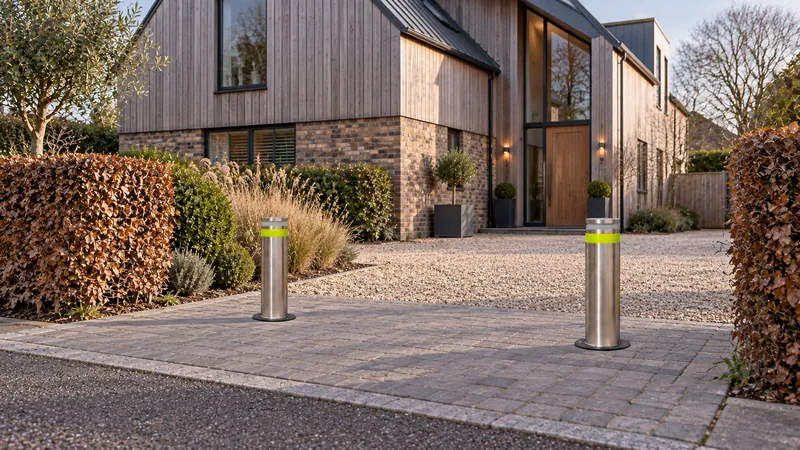
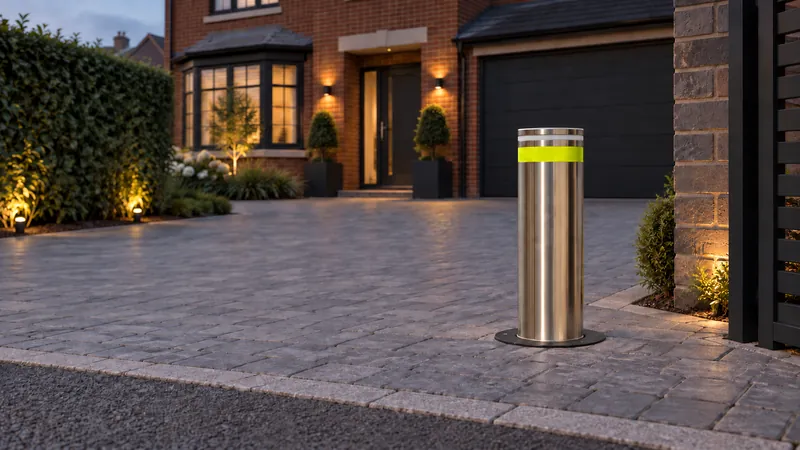
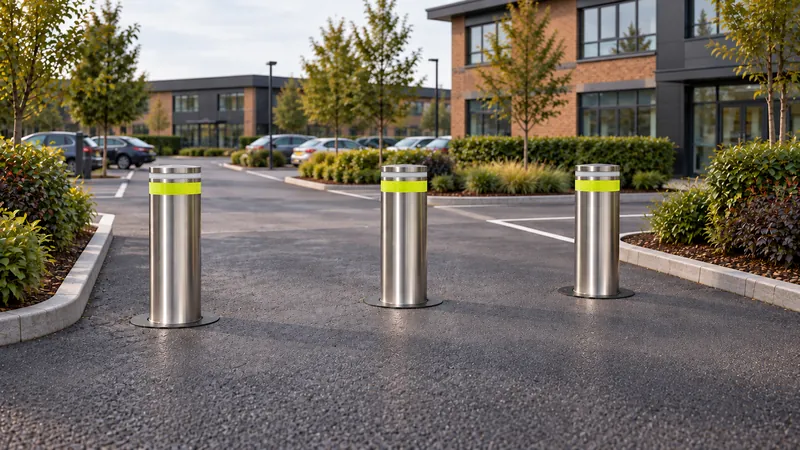
- Stop the car leaving the drive. Tracker recommends physical barriers such as security posts or gates. A raised bollard in front of the car means that even if a thief gets in, they cannot drive it away.
- Light and watch the drive. Security lighting and a camera covering the driveway make a quick, quiet theft harder.
- Fit a tracker. It will not prevent a theft, but it changes the recovery odds dramatically.
No single measure is enough on its own. The strongest set up combines something that protects the key, something that slows a thief down, and something that physically stops the car being moved.
A note on bollards. Boliq bollards are access control bollards, not crash rated barriers. They are designed to stop a car being driven off a driveway, not to stop a vehicle being deliberately rammed through them. They only protect the car when they are raised, which is why ours can be raised from a key fob when you get home, or on a nightly schedule with the app.